What Is Hanbok? Korea's Traditional Clothing Explained
Quick Answer: Hanbok (한복, han-bok) is Korea's traditional clothing culture, built around garments such as the jeogori (저고리), chima (치마) and baji (바지). Its roots reach back to the Three Kingdoms period, while the silhouette most people recognize today was strongly shaped in the Joseon dynasty. Surprisingly, the word "hanbok" itself appears to have emerged only in the late nineteenth century, when Western clothing created a need for a new label.
The Ancient Clothes With a Surprisingly Modern Name
You have probably seen it before. A bright chima moving through a palace courtyard. A short jeogori tied neatly at the chest. Maybe a royal robe in a historical drama. Maybe a tourist posing outside Gyeongbokgung.
And everybody calls it hanbok (한복).
So the word must be ancient too, right? Not quite. The clothing tradition is centuries old. The name is surprisingly young.
The term hanbok, literally "Korean clothing," appears to have emerged in the late nineteenth century as Koreans increasingly encountered Western-style clothing called yangbok (양복). Before that distinction mattered, Koreans did not need a special modern category called "hanbok" -- these were simply the clothes people wore in different forms for different times, classes and occasions.
FRK rule: Hanbok is ancient as a clothing tradition -- but modern as a label.

1. Hanbok Before the Word "Hanbok"
The roots of Korean clothing reach far beyond the Joseon period that dominates historical dramas. Murals from Goguryeo tombs show the basic top-and-bottom structure that would remain central to Korean dress: an upper garment with trousers or a skirt below.
During the Three Kingdoms period, roughly 57 BCE to 668 CE, this basic structure became clearly established. For men: jeogori + baji. For women: jeogori + chima.
The important point is not that people in the seventh century wore exactly the same rental hanbok you see outside a palace today. They did not. The structure endured. The fashion kept changing.
2. Goryeo Made the Story More Colorful
During Goryeo (918-1392), Korean clothing continued to develop through court culture, international exchange, changing silhouettes, fabrics and decorative taste. By this period, color, ornament and material were increasingly powerful visual signals -- though wealth and status still determined how elaborate a garment could be.
3. Joseon Turned Clothing Into Social Information
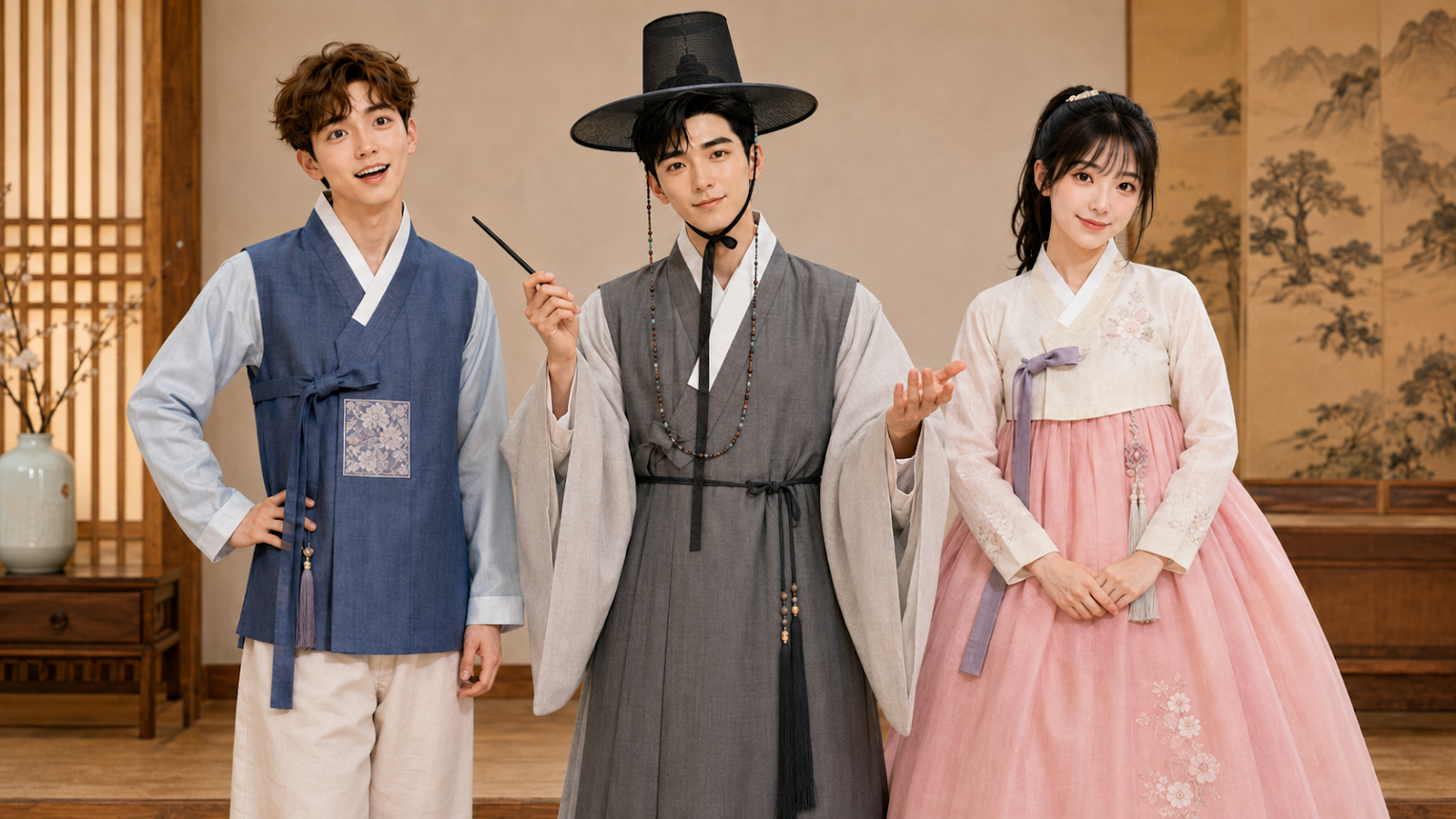
The Joseon Dynasty lasted from 1392 to 1910, and this is the period most international visitors picture when they hear the word hanbok. The mid- and late-Joseon silhouette strongly influenced what is now widely recognized as traditional hanbok, especially the short women's jeogori and high-waisted, full chima.
Joseon clothing was not just fashion -- it was information. Neo-Confucian social order placed strong emphasis on rank, ritual, age and social role, and clothing helped communicate those distinctions through material, color, embroidery, accessories and form.
4. The Five Colors Were More Than Decoration
One of the most recognizable ideas in traditional Korean color culture is obangsaek (오방색), the five directional colors rooted in yin-yang and Five Elements thought: white (west/metal), red (south/fire), blue (east/wood), black (north/water), yellow (center/earth). Color symbolism did not stop at directions and elements -- it could also carry meanings of purity, vitality, prosperity, protection and social position.
5. Saekdong: When the Sleeve Becomes a Celebration
A particularly joyful example is saekdong jeogori (색동저고리), which uses repeated bands of multiple bright colors. It is especially associated with children's clothing and festive occasions -- at a doljanchi (돌잔치, a child's first-birthday celebration), colorful hanbok and saekdong details can become the most memorable visual elements of the day.
6. Then Western Clothes Arrived -- and "Hanbok" Needed a Name
Korea opened its ports in 1876 and entered a period of rapid political, technological and cultural change. Western-style clothing became increasingly visible and came to be called yangbok -- literally Western clothing. Once there was a new category of clothes, the old familiar clothing suddenly needed a contrasting label: hanbok.
Official Korean heritage material says the term is believed to have developed in this context, though the exact first user and date remain uncertain. An 1881 royal record used "Joseon-ui" (조선의), meaning Joseon attire, while a known 1894 newspaper example used the word hanbok.
7. The Gabo Reforms Changed the Dress Rules Too
The Gabo Reforms (갑오개혁) of 1894-1896 were part of Korea's wider attempt to reorganize institutions and modernize society. Older status distinctions in dress were weakened or simplified, official clothing rules were reorganized, and Western-style uniforms became increasingly visible in government and military life -- though the transformation happened gradually, with both clothing worlds existing side by side for decades.
8. Colonial Rule, Industrialization and the Retreat From Daily Life
During the Japanese colonial period (1910-1945) and later through rapid industrialization, Western-style clothing became increasingly dominant in everyday Korean life. Hanbok gradually moved away from being ordinary daily clothing and became more strongly associated with ceremony, family events and tradition.
White clothing had long been widely worn in Korea. During colonial rule, restrictions on white clothing were introduced at various times, yet many Koreans continued to wear it -- and scholars have interpreted this persistence as a form or symbol of cultural and national resistance. It would be too broad to say every person who wore hanbok was consciously protesting, but white traditional clothing did become linked with Korean identity under colonial rule.

Key Facts
| Key fact | Answer |
|---|---|
| Name origin | Late 19th century, to distinguish Korean clothing from yangbok (Western clothing); exact coinage uncertain |
| Historical roots | Basic two-piece structure established by the Three Kingdoms period; visible in Goguryeo murals |
| Familiar silhouette | Strongly associated with mid- and late-Joseon forms |
| Basic women's structure | Jeogori + chima |
| Basic men's structure | Jeogori + baji |
| Obangsaek | Blue=east/wood, red=south/fire, yellow=center/earth, white=west/metal, black=north/water |
| Common today | Seollal, Chuseok, weddings, doljanchi, ceremonies and cultural experiences |
| Living heritage | National Intangible Cultural Heritage designation for hanbok saenghwal in 2022 |
9. Hanbok Did Not Disappear. Its Job Changed.
Today, most Koreans do not wear traditional hanbok to commute to work, buy groceries or go to the gym. Its role changed from daily clothing to cultural and ceremonial clothing -- you may still see it at Seollal, Chuseok, weddings, traditional ceremonies, doljanchi, and family celebrations.
In 2022, Korea designated hanbok saenghwal (한복생활) -- the cultural practice of making, wearing and enjoying hanbok according to occasions and customs -- as National Intangible Cultural Heritage. Notice what was protected: not simply a dress, but a practice, including the knowledge of when, why and how the clothing is made and worn.
10. Court Hanbok, Everyday Hanbok and Modern Hanbok
Not every hanbok is trying to do the same job. Royal and court clothing (gungjung hanbok) could be elaborate, highly symbolic and tied to rank and ceremony, while everyday historical clothing was usually much simpler. Today there is also saenghwal hanbok (생활한복), or modernized everyday hanbok, which adapts traditional lines into lighter, simpler clothes designed for contemporary life.
11. Hanbok Is Having Another Life
The modern revival of hanbok is visible in several places at once. Contemporary designers reinterpret traditional silhouettes with lighter fabrics and modern proportions. K-pop performers and Korean celebrities have worn modified or traditional-inspired hanbok, exposing international audiences to Korean clothing outside historical dramas.
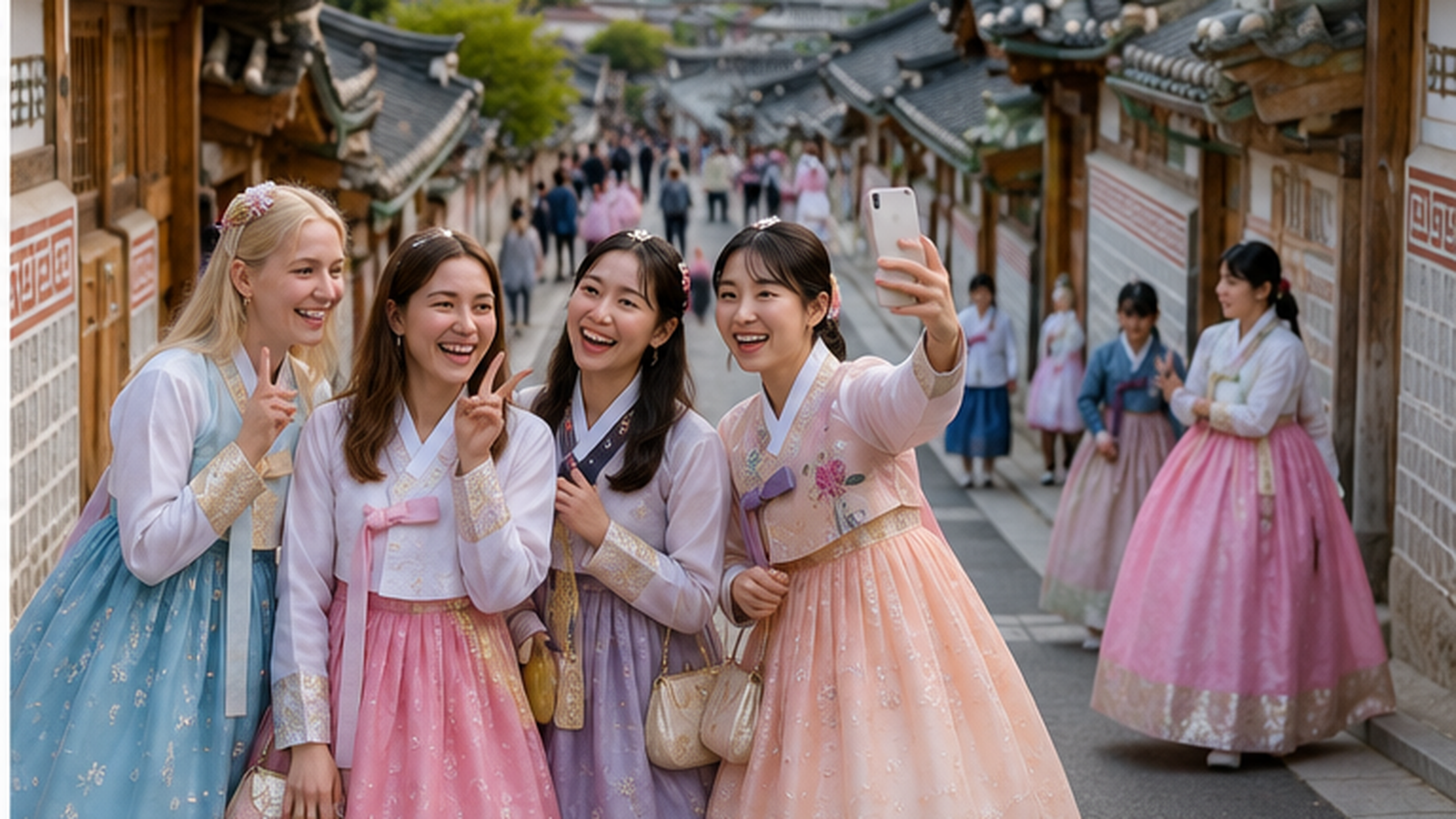
Around Gyeongbokgung, Bukchon and other historic districts in Seoul, hanbok rental shops have become part of the visitor experience. Jeonju Hanok Village is another well-known place where visitors rent traditional clothing and walk through historic surroundings.
Say → Hear → Answer
Imagine you enter a hanbok rental shop near Gyeongbokgung.
SAY: "한복 빌리고 싶어요 (han-bok bil-li-go si-peo-yo)." -- I'd like to rent a hanbok.
HEAR: "몇 시간 대여하세요 (myeot si-gan dae-yeo-ha-se-yo)?" -- How many hours would you like to rent it for?
ANSWER: "네 시간 할게요 (ne si-gan hal-ge-yo)." -- I'll do four hours.
Try It Yourself
If you rent hanbok near a palace, check the rental time, the return deadline, whether hair styling or accessories cost extra, and where your normal clothes and bags will be stored -- then check the palace's current admission and opening rules before you go. Modern rental hanbok is designed for photography, comfort and tourist experience; it should not be treated as a perfect reconstruction of one exact period, but that does not make the experience any less real as modern heritage culture. For a related read on Korean etiquette, see our guide to Korean culture and customs.

Quick FAQ
What does hanbok mean? Hanbok literally means Korean clothing. The term appears to have emerged in the late nineteenth century as Western-style clothing (yangbok) became more visible in Korea.
How old is hanbok? The clothing tradition's roots extend back to ancient Korea, with the basic two-piece structure established during the Three Kingdoms period.
What are the basic parts of hanbok? For women: jeogori + chima. For men: jeogori + baji.
What is obangsaek? The traditional five-color system linked to yin-yang and Five Elements thought -- blue, red, yellow, white and black, each tied to a direction and element.
When do Koreans wear hanbok today? Mostly for special occasions: Seollal, Chuseok, weddings, doljanchi, family ceremonies and cultural events.
🗣️ Local's Note — Haeryong Lee, FRK creator
"Koreans have a real emotional attachment to hanbok, our traditional clothing. But honestly, we don't wear it much these days — not even as everyday wear. It just feels too formal, too 'traditional,' so for most people, the only time they actually put one on is their wedding day. It's kind of a shame, if you ask me."
Sources
Korea Heritage Service / Cultural Heritage Administration -- "Hanbok saenghwal to Be Designated as National Intangible Cultural Heritage" (2022)
Korea.net -- "Hanbok lifestyle designated National Intangible Cultural Heritage" (2022)
National Folk Museum of Korea -- Encyclopedia of Korean Folk Culture, "Hanbok"
The Korea Herald -- Park Yuna, "Hanbok gets dressier for modern celebrations" (May 30, 2026), quoting National Folk Museum of Korea curator Lee Soo-hyun
Victoria and Albert Museum -- "Hanbok - traditional Korean dress" (updated 2024)
Korea.net K-InfoHub -- "Colors and Patterns of Hanbok: Symbolism of Yin, Yang and the Five Elements"
Korea.net / Monthly KOREA -- "Shades of History" (2020)
Ministry of Culture, Sports and Tourism -- "Hanbok, Symbol of Korean Identity" / Monthly KOREA (2025)

Comments